To truly master budget independent travel in Vietnam in 2026, you have to start with a truth the travel industry rarely says out loud: most of what you pay for an all-inclusive package doesn't buy experience — it buys convenience — and you pay dearly for it. On the same 4-day Da Nang trip, the person on a tour pays 6,000,000 VND while the smart independent traveler spends just 3,500,000 VND — and eats better, sleeps in nicer places, and goes exactly where they want instead of being herded through an itinerary designed for 30 strangers.
That's why budget independent travel has become the thing everyone wants to figure out in 2026. This year, the number of Vietnamese choosing to travel independently rather than book a package has surged — partly because the transport infrastructure has improved, and partly because planning tools (booking apps, maps, AI itinerary builders) have made going it alone far less daunting than it was 5 years ago. This handbook takes you from start to finish: setting a realistic budget, timing your trip wisely, comparing ways to get around, eating and sleeping cheap yet well, and a checklist so you don't forget anything before you shoulder your backpack and head out.

Why 2026 Is the "Golden" Year for Budget Independent Travel
A few years ago, traveling independently meant fumbling through everything yourself: calling a guesthouse from a phone number on Google, having no idea which spot was any good, getting lost with a paper map. Now it's completely different. You book a homestay through an app in 2 minutes, read genuine reviews from thousands of travelers before you, and sleeper coaches with massage seats run all the way out to small towns.
More importantly, the 2026 trend leans firmly toward "fewer places, deeper stays." People no longer race through 8 provinces in 5 days just to say they've been; they pick one region, stay longer, eat local food, and spend their money on real experiences instead of factory-line sightseeing tickets. This way of traveling is both more memorable and considerably cheaper — because the biggest cost of any trip is always transport, and the less you move, the more you save.
💡 Tip: The number-one rule of budget travel: cut the number of long journeys, not the quality of where you eat and sleep. A "1 destination, 4 nights" trip is almost always cheaper than "3 destinations, 1 night each" — even when the total number of days is the same.
Setting a Realistic Budget: Which Group Are You In?
The most common mistake is planning in a "just go and figure it out" way — and coming home stunned to have spent double what you expected. The right approach is to pick a per-day budget first, then fit every decision inside that frame. Below are three common budget tiers for one person traveling independently in Vietnam in 2026 (not counting inter-provincial flights or train fares):
| Tier | Budget/day | Sleep | Eat | Best for |
|---|---|---|---|---|
| Backpacker | 300,000 – 500,000 VND | Dorm hostel, shared-room homestay | Street stalls, markets, budget rice eateries | Students, solo travelers, long trips |
| Smart budget | 500,000 – 900,000 VND | Private-room homestay, 2-star hotel | Good local eateries, occasional specialty spots | Couples, groups of friends, most travelers |
| Comfortable | 900,000 – 1,500,000 VND | 3-star hotel, nice homestay with a view | Varied dining, a few restaurant meals | Families, those wanting a light retreat |
These figures work well for most domestic destinations. A few pricier ones (Phu Quoc, Con Dao, a Ha Long cruise) will push the number up 30–50%. Conversely, the northern mountains, the Mekong Delta, or small towns are usually cheaper than the average.
To find out how much a specific destination costs per day, the comparison table in Top 10 Travel Destinations in Vietnam 2026 has an estimated cost-per-day column for each place — very handy for weighing your options before you commit.
💡 Tip: Always set aside 15–20% of your budget as a "contingency fund." A spontaneous entry ticket, a seafood meal worth splurging on, or a downpour that forces you into a taxi instead of walking — these things always happen. With a reserve, you won't agonize over every dong and ruin the mood of your trip.
Timing Your Trip to Avoid Crowds and Pay Less
The same hotel, the same flight route — the price can differ twofold simply because you went at the wrong time. This is the biggest saving lever most people overlook. The general rule is to avoid three "price-surge" windows: Tet and holidays, the long public breaks (April 30 – May 1, September 2), and the summer peak (mid-June to early August) at the hot beach destinations.
The most valuable trick is to go during shoulder season — the stretch right beside the best season but not yet the peak. For example, the central coast in May or early September is still sunny and beautiful, but room rates and flights are 30–40% cheaper than in summer, and it's far less crowded. Da Lat in March–April has clear skies without the summer gridlock. Traveling midweek (Tuesday to Thursday) rather than on weekends also saves a meaningful amount on both rooms and flights.
If you're torn between two classic summer destinations, the article Da Lat or Da Nang for Summer 2026? A Detailed Comparison breaks down the weather, cost, and experience of each place month by month — helping you pick the right time for the right place.
💡 Tip: Booking domestic flights 3–6 weeks ahead usually gets the best price. Turn on price alerts in the airline's app and book early in the morning or midweek — that's when carriers tend to release promo fares to fill empty seats.
Getting Around Domestically: Comparing the Cost of Each Option
Transport eats into a budget the fastest, so this is where careful thought pays off. Every mode has its own strength — choosing the right one for the distance and your wallet can save you a million dong on a single trip.
| Mode | Reference cost | Best for | Notes |
|---|---|---|---|
| Plane | 800,000 – 2,500,000 VND/leg | Long legs (North–South), short on time | Cheap if booked early; add checked-baggage fees |
| Train | 300,000 – 1,200,000 VND/leg | Medium-to-long legs, scenery lovers | 4-berth sleeper is comfortable; the Hai Van pass is gorgeous |
| Sleeper coach | 200,000 – 450,000 VND/leg | Medium legs; overnight saves a night's room | Choose a reputable operator, book a lower-berth seat mid-coach |
| Motorbike rental | 120,000 – 200,000 VND/day | Exploring within a region, flexibility | Requires a license; check brakes/lights before taking it |
| Ride-hailing bike/taxi | Per ride | Short hops within a city | Book via app to know the price upfront and avoid being overcharged |
The classic saving tactic that still works: take an overnight sleeper coach for those 6–9 hour legs. You travel and sleep at once, arrive early in the morning, and save a whole night's room cost. Once you arrive, renting a motorbike is always the cheapest and most flexible way to explore a region — you can stop wherever you like and you're not constantly paying for taxis.
💡 Tip: If you're a group of 3–4 on a short leg (under 150 km), renting a whole 7-seater with a driver is sometimes cheaper than buying 4 separate coach tickets — plus you get door-to-door service and can stop for photos freely. Just divide it out per person before you decide.
Eating and Sleeping Cheap Yet Well
This is the part that makes many people assume "cheap has to mean suffering" — completely wrong. Smart independent travelers often eat better and sleep more interestingly than people on tours; you just pick the right places.
Lodging: homestays and hostels are king
Big hotels charge you for the pretty lobby and the brand; a homestay charges you for the very room you sleep in. For the same money, a private-room homestay is usually more spacious, with a host who recommends places to eat and how to get around like a local friend. A hostel dorm is the cheapest option for solo travelers — saving money and making it easy to find travel companions to split rental costs with. A small tip: filter for ratings of 8.5 and up, read the most recent reviews carefully (not just the score), and prioritize places near the center to cut transport costs.
Eating: follow the locals
An unbreakable rule — any eatery packed with local Vietnamese is both delicious and fairly priced. Steer clear of the places right next to famous tourist spots (inflated prices, declining quality). Eat breakfast and lunch at markets or street stalls, and save your budget for one specialty meal worth splurging on each day. A 30,000–50,000-VND bowl of local bun or pho is far better than a 200,000-VND hotel buffet — and it's the authentic regional flavor.
💡 Tip: Ask your homestay host this straight out: "Where do you usually eat breakfast?" — you'll be pointed to delicious spots no guidebook has. It's the single most effective tip for saving money and eating well, and it's completely free.
To see how these eating-and-sleeping principles apply to a real trip, the article Phu Quoc Independent Travel 2026 breaks down every expense in detail for an island famous for being expensive — and how to keep costs under control.
Tools and Apps for Fast Itinerary Planning
The hardest part of independent travel isn't money — it's the time spent planning. A decent trip can easily swallow a whole evening of flipping through a dozen tabs: which places are worth it, which eateries are good, how long it takes to get from A to B, how to arrange it all sensibly. This is where a good tool saves you the most precious thing — effort.
The minimum toolkit for the 2026 independent traveler: a booking app (to compare prices and read reviews), Google Maps (with points saved offline in case you lose signal), a banking/e-wallet app (scan-to-pay QR is everywhere now, even at small stalls), and an itinerary planner to stitch it all into a coherent plan.
At the final step — turning a scattered "want-to-go" list into a sensible hour-by-hour itinerary — is where ECSATrail AI Planner helps you most. Instead of calculating distances and arranging everything by hand, you just state your destination, number of days, budget, and preferences; the AI builds a session-by-session itinerary, pre-computes the travel time between points, prioritizes verified places, and adjusts the moment you want a change. It doesn't decide where you go for you — it strips out the tedious work so you can save your energy for enjoying the trip. You can read more about how it works in How to Plan Your Trip With AI.
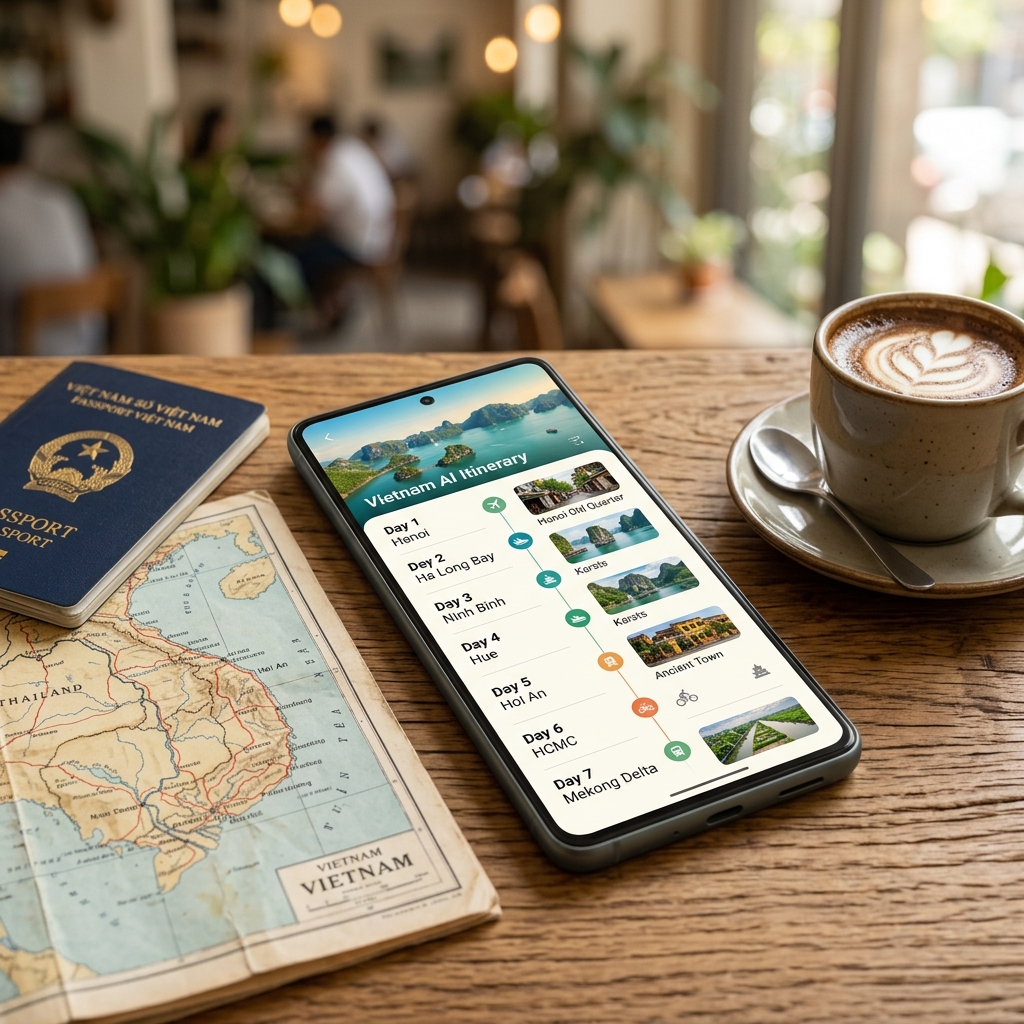
🗺️ Planning to go somewhere this summer? Try ECSATrail AI Planner — enter your destination, budget, and number of days, and the AI builds a detailed independent itinerary in 30 seconds, completely free for a basic plan. It saves you a whole evening of flipping through 10 tabs.
Pre-Departure Checklist
A smooth trip is largely thanks to careful preparation at home. Here's a concise checklist so you don't miss anything important:
- Documents: ID card/passport, driver's license (mandatory if you plan to rent a motorbike), and photos of them saved on your phone in case you lose the originals.
- Book the "sells-out" things ahead: flight/train tickets, the first night at each new place (so you're not hauling luggage around hunting for a room), and any special tours/tickets if you're going in peak season.
- Money: carry a little cash for small stalls and low-signal areas, use QR/card for the rest; notify your bank if you're going somewhere remote to avoid your card being locked for "unusual" transactions.
- Health: personal medication, basic remedies for stomach upset/motion sickness/muscle pain, sunscreen and insect repellent if going to the beach or mountains.
- Electronics: a power bank, charging cables, and download offline maps + your itinerary to your device before you go.
- Check the weather: look at the 3–5 day forecast before your trip to pack accordingly, especially if heading to the central region in storm season or the mountains in the cold season.
💡 Tip: Screenshot your entire itinerary, booking codes, and tickets, then save them to a dedicated photo album on your phone. When you lose signal or your laptop dies, you can still see everything with just your phone — no frantic digging through email.
If you want a suggested route map that links several stops into one longer journey, the article Where to Go Summer 2026 — The Da Nang – Quy Nhon Route is a great example of how to connect points with minimal backtracking while still getting the full experience. And if you love a dreamy old town, check out Hoi An 3-Day, 2-Night Itinerary 2026 to see what a detailed independent itinerary actually looks like.
Frequently Asked Questions (FAQ)
Is independent travel really cheaper than a tour?
In most cases, yes — especially for groups of 2 or more. Going independent lets you choose lodging and food to match your exact budget, avoiding the "hidden" costs tours bundle in (like mandatory shopping stops). Tours are only cheaper on some super-promo low-season deals, but in exchange you lose your freedom and usually get an over-packed schedule. For beginners, the safe path is to travel independently but use an itinerary tool to make up for the lack of experience.
How do you travel solo on a budget?
Solo travelers should prioritize hostel dorms (cheapest and easiest for finding companions to split rental costs), take overnight sleeper coaches, and eat at markets and street stalls. Pick destinations where you can walk or rent a motorbike around the center to avoid spending on taxis. Traveling midweek and in shoulder season will drop room rates further. Important: share your itinerary with family and prioritize safety over saving a few tens of thousands.
How much cash should I carry when traveling independently?
In 2026, QR and cards are accepted almost everywhere in cities, even at small stalls. But the mountains, remote islands, or some local markets still prefer cash. The safe rule: carry enough cash for 1–2 days of basic spending (food, motorbike-taxi rides, small tickets), use QR/card for the rest, and withdraw more as needed. Don't carry too much cash at once.
How do I plan an independent itinerary fast without missing anything?
Start by locking in three "anchors": your travel dates, your main destination, and your lodging. Then list the places you want to visit and group them by area to avoid backtracking. This is exactly the part that's easiest to get wrong and most time-consuming — you can hand it to ECSATrail AI Planner to arrange by distance and sensible time slots, then fine-tune it to your taste in seconds.
Does budget travel mean sacrificing the experience?
No — if you cut in the right places. Smart budgeting means cutting what doesn't create memories (a luxurious hotel room you only sleep in for a few hours, an expensive-but-mediocre tourist restaurant) and investing in what's memorable (a local specialty meal, a coral-snorkeling trip, staying longer somewhere you love). Skilled budget travelers often have richer trips than big spenders, simply because they spend with intention.
Put Budget Independent Travel in Vietnam 2026 Into Practice Today
Budget independent travel really isn't complicated: choose the right time, get around wisely, eat and sleep by following the locals, and let a tool handle the tedious itinerary work. The rest — the new roads, the unexpectedly delicious meals, the friends you meet by chance — is the reason you set off in the first place.
Once you've chosen your destination, let ECSATrail build your initial itinerary framework: tell the AI your budget, number of days, and preferences, and get back an hour-by-hour plan with travel distances already factored in — faster than stitching it together yourself over a whole evening. All you do is tweak it to your taste and shoulder your backpack.
Try the AI Planner for free → | See more travel articles
Read more related articles:
- Top 10 Travel Destinations in Vietnam 2026
- How to Plan Your Trip With AI
- Where to Go Summer 2026 — The Da Nang – Quy Nhon Route
- Da Lat 3-Day, 2-Night Itinerary
- Phu Quoc Independent Travel 2026
- Da Lat or Da Nang for Summer 2026? A Detailed Comparison
- Hoi An 3-Day, 2-Night Itinerary 2026
- ECSATrail Blog